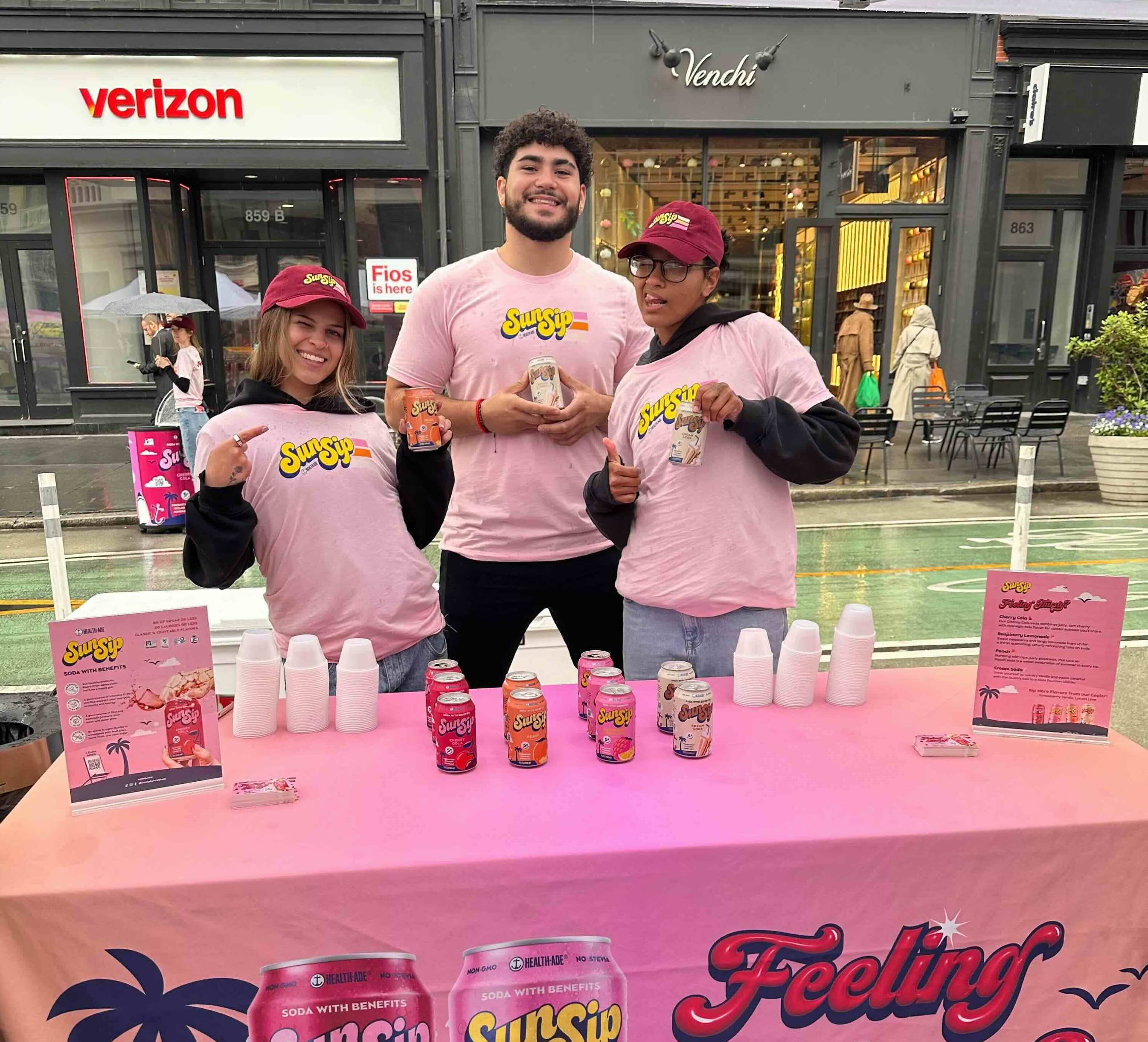
Product sampling marketing is a marketing strategy where a brand distributes free samples or sample-sized products to potential customers so they can experience the product firsthand before making a purchase. In our experience running sampling campaigns, letting consumers try products directly is one of the most effective ways to increase brand awareness, generate buzz, and improve sales and conversion rates.
When people can test an existing product or new products themselves, they are far more likely to trust the brand, leave a positive review, and make future purchases. Many brands use product sampling marketing campaigns to introduce products to new audiences, gather feedback, and build long-term customer loyalty.
At Promobile Marketing , we’ve spent over 10 years helping brands design and execute high-impact product sampling campaigns that reach the right audience. If your business goals include increasing market share, boosting sales, and creating brand loyalists, reach out to us today.
In this guide, we’ll walk through the benefits of product sampling. Along the way, we’ll share real examples, consumer insights, and practical steps to help you create a successful product sampling campaign that generates social proof, encourages customers to share honest reviews, and delivers positive results.
What is Product Sampling Marketing? Product sampling marketing is a marketing strategy where brands distribute free samples or sample-sized products to potential customers so they can try the product firsthand before deciding to purchase. In our experience running sampling campaigns for many brands, product sampling removes hesitation because consumers get to experience the quality, taste, or effectiveness of a product directly.
When customers interact with a product physically, it creates a stronger connection than traditional advertising . Instead of simply seeing a promotion, consumers engage with the product directly, which often leads to higher sales and conversion rates and stronger brand awareness.
One reason sampling marketing works so well is that it taps into basic consumer psychology. When brands give out free product samples, consumers feel more confident about purchasing because the risk of trying something new disappears.
In fact, research shows that about 65% of consumers who sampled a product later purchased it, and 78% of shoppers said trying a sample influenced their purchase decision. In our experience, this is why a well-planned product sampling campaign often delivers better conversion rates than many other forms of marketing. As marketing strategist Dr. Robert Cialdini famously explains, the principle of reciprocity plays a role here. When brands provide value first, consumers feel more inclined to respond positively, often through future purchases or brand engagement.
You’ll see product sampling marketing campaigns used across many industries. Food and beverage companies frequently run in-store sampling in grocery stores to introduce new products or increase visibility for an existing product. Beauty and skincare brands often send free samples through subscription boxes, influencer sampling, or direct mail sampling to reach a broader target audience online. We’ve also seen brands run highly effective event sampling campaigns at festivals, university campuses, and experiential marketing events where customers can interact with the brand while trying the product. For instance, a soap manufacturer might distribute sample-sized products at wellness events to introduce their natural ingredients to potential customers.
Top Strategies for Successful Product Sampling Marketing Campaigns The first step in a strong product sampling strategy is targeting the right audience . Many brands assume that giving samples to as many people as possible will automatically boost sales, but in our experience, success depends on reaching the target market most likely to purchase the product.
For instance, if a soap manufacturer launches a natural skincare line, distributing sample-sized products at wellness events, fitness studios, or university campuses may be far more effective than distributing them randomly in a crowded store. When potential customers try products firsthand in an environment that aligns with their lifestyle, they are much more likely to leave a positive review, share the experience with others, and make future purchases.
Choosing the right products for sampling is equally important. Not every existing product is suitable for a sampling campaign, so brands should focus on items that provide an immediate and noticeable experience. Food, beverage, beauty, and personal care products are particularly effective because consumers can instantly evaluate the product after trying it.
For example, offering free samples of a snack in grocery stores or distributing skincare sample-sized products through subscription boxes allows customers to test the product before committing to a full purchase. In our experience, many brands launching new products use product sampling marketing to quickly build brand awareness and gather valuable consumer insights about how the market responds.
Another key factor in a successful product sampling strategy is selecting the right distribution channels. In-store sampling in retail stores remains one of the most popular product sampling strategy approaches because customers can try the product and immediately decide to buy it. This often leads to strong conversion rates because the product is available at the moment of interest. Another effective method is direct mail sampling, where brands send samples directly to households within a specific target audience. This strategy is especially powerful for brands that sell through an e-commerce site, because consumers can try the product and then quickly place an order online.
Brands also increasingly use influencer sampling to encourage creators to test new products, generate user generated content, and provide an honest review that creates social proof. In addition, event sampling campaigns at festivals, conferences, and university campuses allow brands to introduce products to new audiences while creating memorable brand experiences.
Measuring the success of your product sampling marketing campaigns is just as important as distributing the samples themselves. In our experience, brands that track performance metrics consistently gain deeper consumer insights and improve their campaigns over time. Key indicators include sales, conversion rates, the number of positive reviews, and whether the campaign helped increase sales or expand market share. Some brands also track how many customers join loyalty programs or become repeat buyers after trying sampling products.
For example, we worked with a beverage company that distributed free product samples at sporting events and grocery stores. Their sampling campaign included QR codes that directed customers to the brand’s e-commerce site, allowing the company to track data and measure purchase behavior. Within a few months, the efforts led to a measurable increase in brand awareness, stronger user engagement, and a noticeable lift in sales.
Benefits of Product Sampling Marketing for Brands in the United States Product sampling marketing has become one of the most reliable ways for brands in the United States to introduce new products, build brand awareness, and improve sales and conversion rates. Below are some of the most significant benefits of product sampling for brands operating in the U.S. market, supported by research and real campaign examples.
Increased Brand Trust Among US Consumers One of the most powerful benefits of product sampling marketing is its ability to build trust with consumers. When brands offer free samples, it signals confidence in the quality of their products, which can significantly influence perception.
According to research published by the National Institutes of Health , consumers tend to perceive products more positively when they have the opportunity to physically interact with or experience them. Studies on consumer behavior and decision-making show that direct experience with a product can significantly influence attitudes toward a brand and purchasing decisions.
In our experience, this effect becomes even stronger when product sampling campaigns are done in interactive environments such as retail stores, pop-up events, or event sampling campaigns. For instance, alternative protein brand Meati Foods ran a sampling activation in the United States where participants tried its meat-free products during blind taste tests. Consumers were invited to compare the product with traditional chicken, and the experience generated strong consumer insights and positive reviews, helping the brand increase brand awareness among non-vegetarian audiences. From our perspective, this is a great example of how a successful product sampling strategy can build brand loyalty by showing customers that the company stands behind its product quality.
Boost in Product Trial and Conversion Rates Another major advantage of sampling marketing is the ability to dramatically increase product trial and improve sales and conversion rates. When potential customers get to test a product before committing to a purchase, it reduces uncertainty and encourages buying behavior.
Research highlighted by the Event Marketing Institute found that 65% of consumers who sampled a product went on to purchase it, and 78% said the opportunity to try the product influenced their decision. These findings demonstrate how product sampling can turn curiosity into actual sales.
We’ve seen similar results firsthand. For example, a beverage brand we worked with launched an in-store sampling program in grocery stores across several U.S. cities. The campaign distributed sample-sized products to shoppers while they were already in a purchasing mindset. Within weeks, the sampling campaign helped the brand boost sales significantly in participating stores, while also introducing the drink to new audiences. This is why many brands consider product sampling marketing strategies one of the fastest ways to increase sales and grow market share when launching new products.
Opportunities for Direct Customer Feedback Another overlooked advantage of product sampling marketing campaigns is the opportunity to gather feedback directly from consumers. Unlike traditional advertising, a sampling campaign allows brands to interact with customers in real time and collect valuable data and consumer insights.
In some cases, brands combine sampling products with surveys, QR codes, or digital forms that encourage participants to leave an honest review or share their experience. According to the U.S. Small Business Administration, gathering customer feedback and market data is essential for improving marketing strategies and refining products before scaling distribution.
For example, Meati Foods conducted a mobile focus group style sampling campaign where participants tried its meat-free products and provided detailed feedback on taste and texture. The campaign allowed the brand to refine messaging and positioning before expanding distribution across U.S. retail stores. In our experience, campaigns like this help brands collect actionable consumer insights that can guide future marketing decisions and product improvements.
Sampling Creates a Positive Impression Consumers often develop a more favorable perception of brands that offer free samples. Simply providing free product samples demonstrates confidence in the product and can elevate the brand in the minds of buyers.
Marketing research frequently highlights the psychological principle of reciprocity, where people feel inclined to respond positively when they receive something of value. As behavioral science research referenced by the American Marketing Association explains, reciprocity plays a powerful role in shaping consumer behavior and purchase decisions.
We’ve seen this play out in many product sampling marketing campaigns, especially at pop-up stores, trade shows, and event sampling campaigns where consumers can try the product and buy it immediately. In these situations, the experience often leads to positive results such as higher conversion rates, increased user engagement, and more positive reviews shared online.
Sampling Sparks a Sense of Obligation When someone gives us a gift, we feel an obligation, however slight, to reciprocate. “People have a natural desire to treat others well, pay back their debt and return favors,” says a blog post on peekage.com
“Reciprocity is a very, very strong instinct,” says a blog post on lightspeed.com . “If somebody does something for you, you really feel a rather surprisingly strong obligation to do something back for them.” Brands that both sample and sell products at pop-up shops, trade shows, and expos can benefit most immediately from reciprocity bias, because attendees who sample on-site will be more likely to “repay” the brand by making a purchase.
Sampling Is Risk-Free for the Consumer Another reason product sampling marketing works so well is that it removes the perceived risk of trying a new product. When consumers receive free samples, they can evaluate the product without spending money.
Behavioral science research discussed by organizations like the American Psychological Association explains that people often prefer choices that appear to involve zero risk. In marketing terms, this means free product samples lower the barrier to trial and make consumers more open to exploring unfamiliar brands.
A good example is the haircare brand Amika , which launched a sampling activation across several U.S. cities to promote a new anti-frizz product. By allowing consumers to test the product through sampling, the brand reduced purchase hesitation and encouraged participants to later buy the full-size product. From our experience, this “risk-free trial” approach is one of the most effective ways to encourage customers to explore new products and eventually become loyal customers.
Sampling Puts Your Product at the Front of Consumers' Minds When we humans need to evaluate a product or a concept, we tend to assign importance to whatever we can recall — and what we're most likely to recall is whatever is available to us. If we can remember it, our logic goes, it must be important. This is known as the “availability heuristic.”
“Free samples make your brand available, and therefore important and memorable for buyers,” says peekage.com. “And when buyers want to choose between different brands, they go with the one that they remember first.”
Sampling Builds a Relationship Experiential marketing is all about giving potential customers a firsthand experience with your brand — and what's more firsthand than a product sample?
Sampling is effective at building relationships because it plays on the anchoring effect. “The first piece of information a buyer receives from a product plays an important role in the process of decision making,” says peekage.com .
One real-world example is when Food and beverage brand Knorr wanted to promote the new liquid format of its chicken bouillon by showing consumers one way to use it in chicken tacos. The brand's sampling campaign gave away 1,500 tacos, creating a delicious first impression and a strong incentive to buy for consumers who'd never tried the product. Product sampling makes buyers build a personal relationship with the product.
Sampling Method
Cost
Reach
Engagement Level
Measurement
Ideal Product Types
Event Sampling Campaign
Moderate to High depending on the size, staffing, and logistics
Medium to High depending on the event and location
Very High because consumers experience the product firsthand and interact with the brand
Moderate – requires tracking data, surveys, and post-event purchase behavior
food, beverages, beauty products, wellness products, new products launching to the market
In-Store Sampling
Moderate since brands must coordinate with retail stores and provide staff and sample-sized products
Medium but highly targeted because it reaches shoppers already in a buying environment
High because consumers try the product while shopping, which often improves sales and conversion rates
High – sales can be tracked directly at the store during and after the sampling campaign
Snacks, beverages, grocery products, personal care items commonly sold in grocery stores
Direct Mail Sampling
Moderate to High depending on mailing volume and direct distribution costs
Very High because brands can send samples to thousands of households within the target market
Medium – engagement depends on whether customers open and try the free samples
High – brands can track responses using QR codes, coupons, or e-commerce site purchases
beauty products, personal care items, supplement samples, product trials easily shipped
Digital Sampling
Low to Moderate compared to physical distribution methods
Very High because brands can reach large online audiences quickly
Medium to High when combined with influencer sampling, user-generated content, and honest review requests
Very High because digital campaigns generate measurable data including clicks, sign-ups, and conversion rates
beauty products, skincare, packaged goods, subscription products, often promoted through subscription boxes
How Promobile Marketing Executes Effective Product Sampling Marketing One of the key strengths of Promobile Marketing is our ability to create tailored sampling campaigns based on a brand’s target market, product type, and distribution channels. Every product sampling strategy we develop begins with understanding the target audience and identifying where potential customers are most likely to interact with the product.
Another advantage of working with Promobile Marketing is our focus on mobile marketing integration and data-driven targeting . Because we specialize in experiential and mobile marketing activations, we’re able to bring products directly to consumers through branded vehicles, pop-up experiences, and interactive sampling environments.
These campaigns allow consumers to experience products firsthand, which often leads to higher conversion rates, stronger user engagement, and increased future purchases. At the same time, we collect valuable data from each sampling campaign, allowing brands to track performance, analyze consumer insights, and measure how the campaign helped increase sales or expand market share.
As Dominick Tomanelli, CEO & Co-founder of Promobile Marketing, explains: “Product sampling is one of the most powerful ways to connect a brand with consumers because it removes the barrier between curiosity and experience. When people can try a product firsthand, it builds trust immediately. Our goal at Promobile Marketing is to design sampling campaigns that don’t just distribute samples, but create memorable brand experiences that drive engagement, loyalty, and measurable sales.”
Need Help With Product Sampling Marketing? If you’re looking to launch a product sampling marketing campaign that truly connects with your target audience, working with the right partner can make all the difference. In our experience, brands see the best positive results when their product sampling strategy is carefully planned.
A well-executed sampling campaign doesn’t just distribute free product samples. It helps increase brand awareness, gather valuable consumer insights, generate user engagement, and ultimately increase sales.
Ready to launch a successful product sampling campaign? Contact Promobile Marketing today to start building a customized product sampling marketing strategy that puts your products directly in the hands of consumers and drives measurable sales and conversion rates.
FAQs Based on our experience running product sampling marketing campaigns for many brands, the answers below highlight how sampling marketing works, why it is effective, and how businesses can use it to increase brand awareness, boost sales, and build stronger relationships with customers.